Proposal 2: Help the witch buy the missing objects!
Social organisation
Pairs.
Timing
20 minutes.
Objectives
-
Role-play a buying-shopping situation, a daily life activity.
-
Use euros and cents appropriately.
-
Ask for the prize of an object.
-
Count their money and pay.
-
Calculate the money they have to get back (subtraction).
-
Name key vocabulary related to the topic.
-
Produce short sentences about money, both orally and in a written format.
-
Work collaboratively with partners.
Content
-
Comprehension of simple instructions accompanied by visual supports.
-
Writing of words from oral productions.
-
Use of verbal and non-verbal resources to communicate with others.
-
Relation of symbols, pronunciation and meaning from written models and oral expressions. Intuitive use of decoding.
-
Formulation of questions and answers in simulations and dialogues.
-
Application of decimal numbers in real contexts (cents for shopping).
-
Knowledge and use of the monetary system in real contexts: euros and cents.
-
Comprehension and use of counting strategies.
-
Use of verbal, graphic and symbolic language to represent numbers.
-
Collaborative work.
-
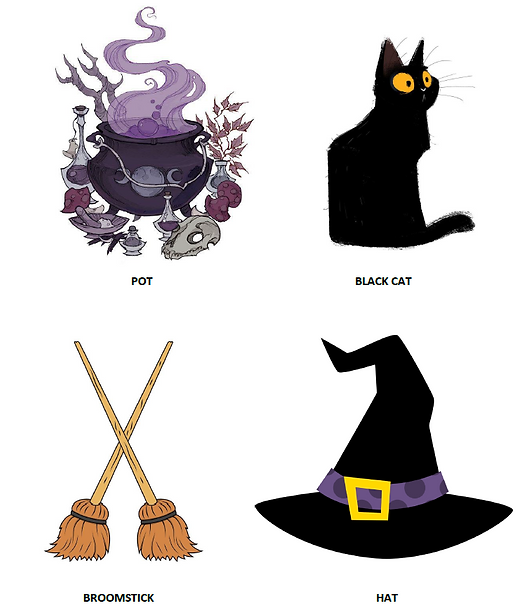
Vocabulary related to the witch: pot, potion, book, broomstick, black cat, hat.
-
Structures: the witch needs a… How much is it? / It costs…/ I have got…/ I give back…
Description
Role-play a shopping situation. One of the students is the client and the other is the shop assistant; they change roles after some time.
The client has some possible objects to buy, from which he/she chooses the ones that belong to a witch. When he/she has decided on one, says: “The witch needs a … How much is it?” Then the shop assistant has to answer: “It costs… €” The client has a certain amount of money and pays for the costume: “I have got…€” The shop assistant then has to give some money back: "I give back …€”. After role-playing the situation, students summarize it by completing some sentences in their notebooks.
Material and scaffolding


Objects cut-outs:

Flashcard with grammar structures:

Flashcard with instructions:


Attention to diversity
First and second graders develop the activity only with 1€ and 2€ coins, and notes. Third graders start with the same material, but cents may be introduced if they feel it too easy. First and second graders, who still present difficulties with writing, are provided a worksheet with the sentences so they only have to complete them with the money. Older students who present writing difficulties may use it as well. Third graders are provided some flashcards with grammatical structures and vocabulary, and along with the sentences stated orally they complete them on their own.
Assessment
Students complete the worksheets in the notebook.
Also, they do a self-assessment of whether they liked the activity or not by circling the face that better represents what they feel, and another self-assessment for the understanding of the activity by circling the image that better represents their understanding.


1st- 2nd grade 3rd grade