Proposal 4: Help the magician organise his objects!
Social organisation
Pairs.
Timing
15 minutes.
Objectives
-
Recognize and name geometrical shapes.
-
Associate a certain geometrical shape to an object.
-
Name key vocabulary related to the topic.
-
Understand teacher statements by placing objects in the appropriate box.
-
Produce a short sentence to describe the actions developed, both orally and in a written format.
-
Work collaboratively with partners.
Content
-
Comprehension of simple instructions accompanied by visual supports.
-
Writing of words from oral productions.
-
Use of verbal and non-verbal resources to communicate with others.
-
Relation of symbols, pronunciation and meaning from written models and oral expressions. Intuitive use of decoding.
-
Recognition of two-dimensional shapes in real-life objects.
-
Designation of two-dimensional figures: triangle, square, circle.
-
Use of verbal, graphic and symbolic language to represent numbers.
-
Collaborative work.
-
Vocabulary: geometrical shapes and objects related to the shapes (ball, earth globe, fried egg, clock, wheel, pyramid, ice cream, music triangle, tipi tent, mountain, ice cube, dice, pillow, present, computer)
-
Structures: the … goes in the … box.
Description
Students review the name of basic geometrical shapes in English (circle, square, triangle) using the flashcards. Then they are told the magician has taken some objects out of his hat, and they have to be organised in their corresponding boxes, according to their shapes. Each box is labelled with a particular shape, and students have to place the cut-outs of objects while saying: “the (object) goes in the circle/square/triangle box”. Afterwards they complete a worksheet on their notebooks.
Material and scaffolding


Objects cut-outs:


Labels for boxes:
Flashcard with grammar structures:
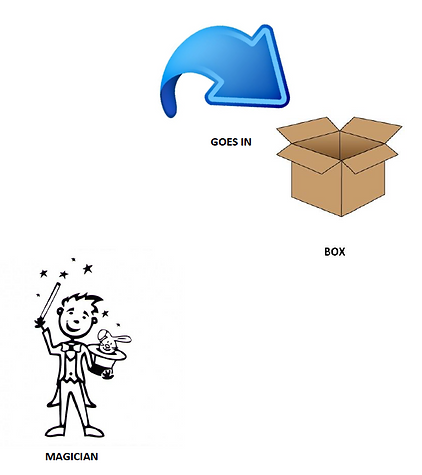
Flashcard with instructions:

Attention to diversity
Attention to diversity: First graders, who still present difficulties with writing, are provided a worksheet with pictures of the objects and pictures of the boxes, and they related them with a line. Older students who present writing difficulties may use it as well. Second and third graders are provided the same activity and also some flashcards with vocabulary, and along with the sentences stated orally they complete a similar sentence on their own.
Assessment
The teacher checks if students have ordered the objects properly in the corresponding boxes. Students complete a worksheet on their notebooks, where they have to relate the objects to the corresponding boxes, and complete a sentence about one of the objects.
Also, they do a self-assessment of whether they liked the activity or not by circling the face that better represents what they feel, and another self-assessment for the understanding of the activity by circling the image that better represents their understanding.


1st- 2nd grade 3rd grade